Benchmark 1: Wakes, Diurnal Cycle
Case Study
The goal of this benchmark is to simulate the area around the King Plains and Armadillo Flats wind farms on 24 August 2023. The size of the modeling domain is left to the participants, however, we recommend to include both wind farms to be able to capture their interaction during the day to simulate.
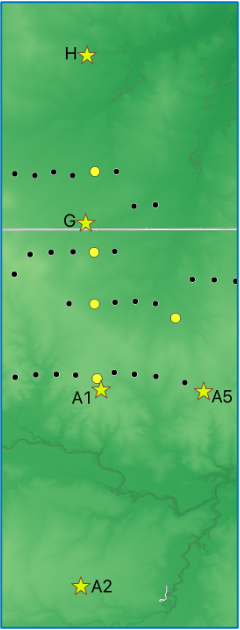
IF the above is not possible, we recommend participants to focus on the region in the map below, to maximize chances for a valuable comparison across models. IF only selected time periods can be afforded, please focus on periods from 05-07 UTC and 17-19 UTC.
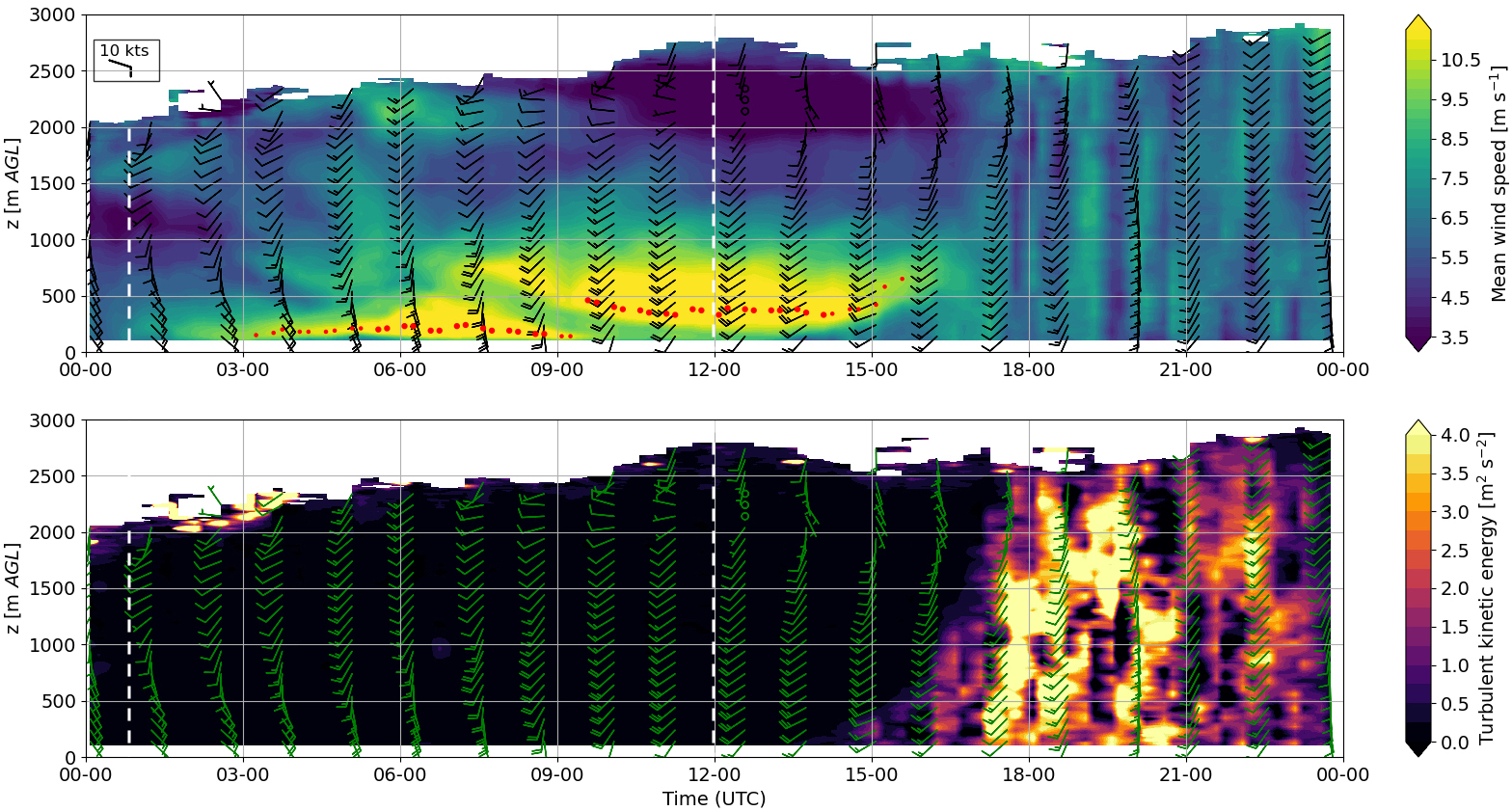
The figure below shows the observed wind speed, wind direction and lidar-derived TKE at AWAKEN site A1 on the selected case study. The vertical dashed lines show local sunset (left) and sunrise (right).
Validation Objectives
The goal of this benchmark is to evaluate the models’ ability to accurately capture:
- Wake (at both farm and turbine levels) characteristics
Momentum deficit
Turbulence increase
- Impacts on downstream wind plants
Power generation
- Impacts on downstream environment
Temperature
- Effects of inflow conditions
Wind speed
Wind direction
Turbulence
Atmospheric stability
Shear and veer
- Effects of geometry
Plant layout
Turbine size
Topography
Simulation Tools
All simulation tools are welcome to participate in this benchmark. This includes, but it is not limited to:
Mesoscale models, with different wind farm parameterizations
Steady-state analytical models
Dynamic wake meandering-type models
Engineering models
Large-eddy simulation (LES), both coupled to mesoscale or run at the microscale only
Reynolds-averaged Navier–Stokes (RANS) simulations
Machine learning models
Guidelines
Participation in the benchmark is open to participants from countries that are part of the IEA Wind Task 57 “JAM”. Please contact paula.doubrawa@nrel.gov for further information about this.
Simulation tools should be used to the limit of their capabilities. 2D, steady-state solutions will be accepted for low-fidelity models. 3D, time-varying solutions will be expected from mid-to-high fidelity models.
The choice of domain size, grid spacing, time step, and other model configuration parameters is left to the discretion of the participants.
Multi-model benchmark results will be published in journal article and co-authored by all participants who choose to release their results and participate in the publication effort.
All provided results must observe the variable definitions and units as explicitly defined in the glossary.
Team
A large team of researchers have participated to the preparation of this benchmark. The benchmark lead is Nicola Bodini (nicola.bodini@nrel.gov), feel free to reach out to him with questions!